
 gregorianka.belynichi@gmail.com
Prayer for the dead in the Bible and the tradition of the Church
How does the Church know that it is right and worthwhile to pray for the dead? We quote 2 Maccabees 12, the witness of Tertullian, St Cyril, St Augustine and St John Chrysostom, and the Catechism's teaching on the communion of saints and the Eucharist offered for the dead.
In brief
Prayer for the dead is grounded in Sacred Scripture – most clearly in the Second Book of Maccabees (2 Macc 12:43–46) – and is attested in the Church from the first centuries: in Tertullian, St Cyril of Jerusalem, St Augustine and St John Chrysostom. Its foundation is the communion of saints – the unity of believers on earth, the dead who are being purified and the saints in heaven (CCC 962). From the beginning the most important form of this prayer has been the Eucharist offered for the dead (CCC 1371); Gregorian Masses are one of its traditional forms.
The Second Book of Maccabees – the text
After a battle Judas Maccabeus discovered that the fallen had been carrying objects connected with the worship of idols. The Bible describes his response as follows:
“He also took up a collection, man by man, to the amount of two thousand drachmas of silver, and sent it to Jerusalem to provide for a sin offering. In doing this he acted very well and honourably, taking account of the resurrection. For if he were not expecting that those who had fallen would rise again, it would have been superfluous and foolish to pray for the dead. But if he was looking to the splendid reward that is laid up for those who fall asleep in godliness, it was a holy and pious thought. Therefore he made atonement for the dead, that they might be delivered from their sin” (2 Macc 12:43–45, RSV).
This short passage contains three elements that have endured in the practice of the Church: a sacrifice offered for the dead, a gift of the community (the collection that paid for it) and faith in the resurrection as its justification. The Catechism refers to this text when it speaks of purification after death (CCC 1032). We discuss the historical context and the significance of this book in the debate with Protestants on the page prayer for the dead, and the teaching on purification in purgatory in the teaching of the Church.
The New Testament
The New Testament contains no command to pray for the dead, but it does have a passage that many commentators read in this light. St Paul writes of Onesiphorus: “May the Lord grant mercy to the household of Onesiphorus […]; may the Lord grant him to find mercy from the Lord on that Day” (2 Tim 1:16.18). The Apostle speaks of the household of Onesiphorus, and of the man himself in the past tense; hence the supposition that Onesiphorus was no longer alive. The text does not say so directly, so we treat it as a possible rather than a certain indication. More important is what the Church received from the faith of Israel and developed in the light of Christ's resurrection.
The Fathers of the Church
Tertullian (c. 200)
In his treatise On the Crown Tertullian lists customs that Christians received from Tradition: “Oblationes pro defunctis, pro nataliciis, annua die facimus” – “We make offerings for the dead and for their birthdays [into heaven] every year, on the anniversary” (De corona 3). In On Monogamy he describes a widow who “prays for his soul, asks for refreshment for him […] and makes an offering on the anniversaries of his falling asleep” (De monogamia 10). This is one of the oldest witnesses to the custom we now call an anniversary Mass for the dead.
St Cyril of Jerusalem (4th century)
In his catecheses for the newly baptised, the Bishop of Jerusalem explains that in the Eucharistic Prayer we remember “all who have fallen asleep before us”, in the belief that it is a great benefit to the souls on whose behalf the supplication is offered, “while the holy and tremendous Victim is present”. The Catechism quotes this text precisely where it speaks of the Eucharist for the dead (CCC 1371; Mystagogical Catecheses 5:9–10).
St Augustine and St Monica (4th/5th century)
Many of the faithful know the request of the dying Monica – to be remembered “at the altar of the Lord”. Less well known are two further passages of Book IX of the Confessions. Augustine records that at her grave, before the body was laid to rest, “the sacrifice of our redemption was offered for her” (IX 12,32). And he ends the book with a prayer that God would inspire his readers, “that as many as read these words may remember at your altar Monica, your servant, together with Patricius, once her husband” (IX 13,37). A son who was himself a bishop asks strangers to pray at the altar for his parents – it is hard to imagine a more beautiful picture of what a requested Mass for the dead is.
St John Chrysostom (4th/5th century)
The Catechism quotes his encouragement to help the dead and remember them: if Job's sons were purified by the sacrifice their father offered (Job 1:5), we have no reason to doubt that our offerings for the dead bring them some consolation (CCC 1032).
Two centuries later St Gregory the Great described in his Dialogues thirty Masses offered for the deceased monk Justus – it is from him that Gregorian Masses take their name.
The communion of saints – why it makes sense
Prayer for the dead is not a magical “transfer” of merits, but an expression of the unity of the Church. The Catechism, following the Credo of the People of God of Paul VI, professes faith in the communion of all the faithful of Christ – those who are pilgrims on earth, the dead who are being purified and the blessed in heaven – all together forming one Church (CCC 962). That is why our prayer for the dead “is capable not only of helping them, but also of making their intercession for us effective” (CCC 958). Love does not end with death – it only changes the way it is expressed.
The Eucharist for the dead and Gregorian Masses
From the Maccabees to Augustine the same theme returns: a sacrifice is offered for the dead. In the New Covenant this is the one Sacrifice of Christ, made present in every Mass and offered “also for the faithful departed who have died in Christ but are not yet wholly purified” (CCC 1371). Gregorian Masses add nothing new to this Sacrifice – they are a persevering offering of it for thirty days for one person, after the pattern of what Monica asked for. You will find practical guidance in our guides Mass for the dead and what are Gregorian Masses, and you can submit an intention through the page request Gregorian Masses.
Sources
- Holy Scripture of the Old and New Testaments (Biblia Tysiąclecia, in Polish): 2 Macc 12, 2 Tim 1; English quotations from the Revised Standard Version
- Catechism of the Catholic Church, nos. 958, 962, 1032, 1371 – vatican.va
- Tertullian, De corona 3; De monogamia 10 (Latin text; our own translation)
- St Augustine, Confessiones IX 11,27; 12,32; 13,37 (Latin text; our own translation)
- St Cyril of Jerusalem, Mystagogical Catecheses 5:9–10 (as quoted in CCC 1371); St John Chrysostom, Homilies on 1 Corinthians 41:5 (as quoted in CCC 1032)
Questions and answers
Do the Orthodox also pray for the dead?
Yes. The Orthodox Churches accept the Second Book of Maccabees and have prayed for the dead for centuries, including during the Divine Liturgy. Prayer for the dead therefore unites Catholics and Orthodox.
Does prayer for the dead replace the Mass?
It does not replace it but complements it. The Rosary, the “Eternal rest”, an indulgence or almsgiving are precious (CCC 1032), but the Eucharist comes first, because it is the Sacrifice of Christ. It is best to combine the two – for example, by praying at home during the days when Gregorian Masses are being celebrated. See also the indulgence for the dead.
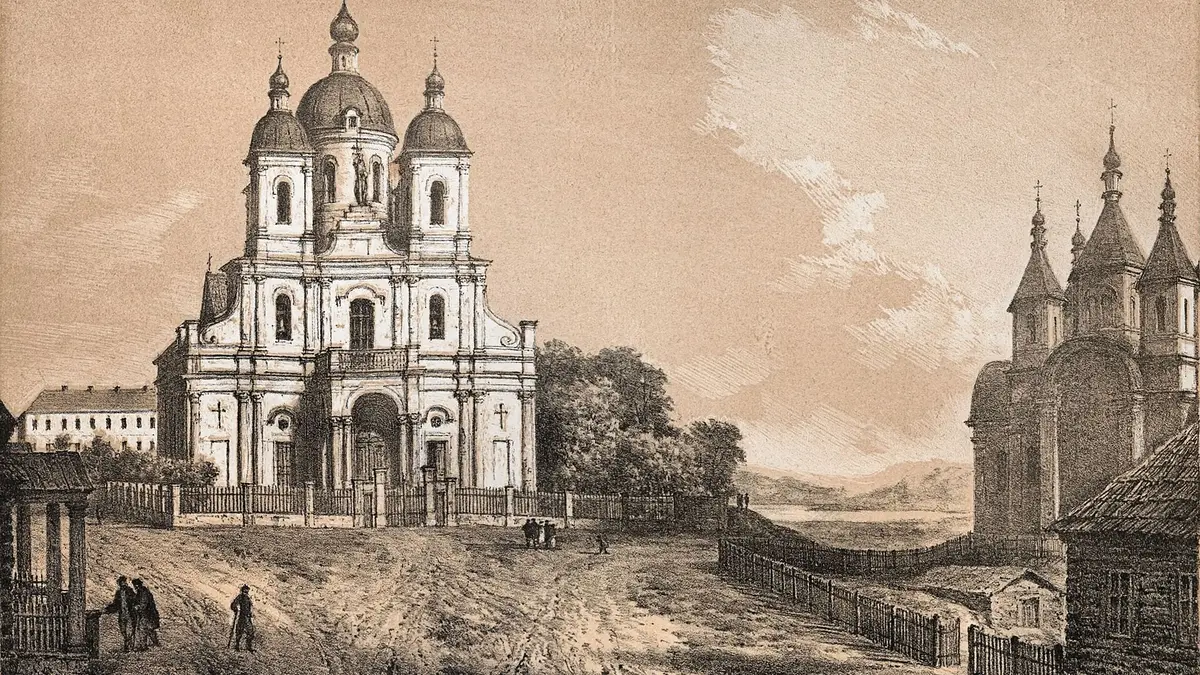
The Shrine of Our Lady of Białynicze
For centuries Białynicze on the River Drut was one of the most important Marian shrines of the Polish–Lithuanian Commonwealth, known as the “Częstochowa of Belarus”. The Carmelite church with the miraculous image of Our Lady, crowned in 1761, was destroyed in Soviet times.
Today the parish is rebuilding the shrine, and every Mass requested here supports this work.
History of the shrine →Request a Holy Mass
Leave your contact details and intention – we will reply by e-mail with a proposed date.
Thank you! We have received your request and will reply shortly to the e-mail address you gave.