
 gregorianka.belynichi@gmail.com
Mass for the Dead – Its Meaning and How to Request One
Holy Mass is the first and greatest gift the Church offers for the dead. We explain what the Catechism says about it, which Masses can be requested, when to do so and how to word the intention – and also how to request a Mass for a deceased person online in the parish in Białynicze.
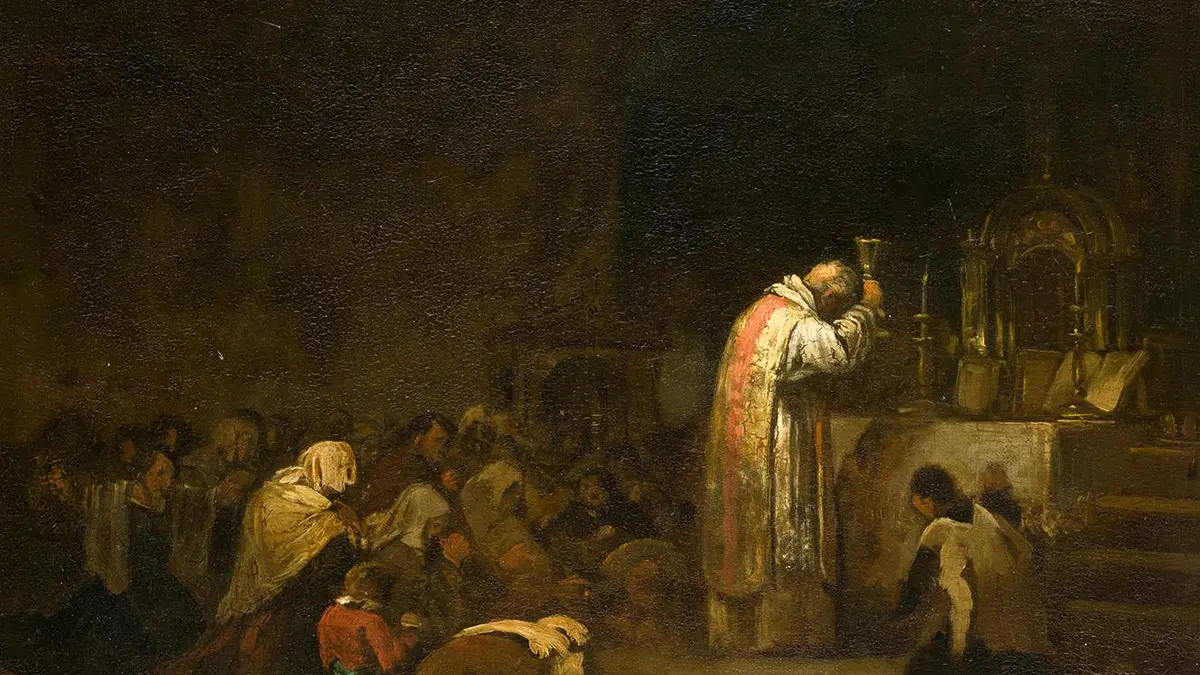
Why the Church offers Holy Mass for the dead
Prayer for the dead is not a pious addition to the faith but a consequence of it. Since we believe in the resurrection and in the communion of saints, we also believe that death does not sever the bond between us and those who have gone before us. The Catechism of the Catholic Church teaches that the Eucharistic sacrifice is also offered for the faithful departed “who have died in Christ but are not yet wholly purified”, so that they may be able to enter into the light and peace of Christ (CCC 1371).
In the same place the Catechism recalls the words of the dying St Monica, recorded by her son, St Augustine: she asked that no one should trouble about where she was buried, but that she should be remembered at the altar of the Lord. It is a request that many of us have heard – in words or without them – from our own parents and grandparents.
CCC 1032 adds that from the earliest times the Church has honoured the memory of the dead and offered prayers for them, “above all the Eucharistic sacrifice”, so that, thus purified, they may attain the beatific vision of God. The Church also commends almsgiving, indulgences and works of penance undertaken on behalf of the dead.
Does Mass help the dead?
Holy Mass is not “our” prayer in the ordinary sense. On the altar the one Sacrifice of Christ is made present, and we ask that its fruits may reach a particular person. That is why the Church puts the Eucharist first among the ways of helping the dead. The Church calls the purification after death purgatory.
At the same time we must speak honestly: we do not know the state of the soul of the deceased and we cannot measure the effects of prayer. When we request a Mass, we do not “arrange” salvation but trustingly commend our loved one to God's mercy. Benedict XVI wrote in the encyclical Spe salvi (48) that our prayer for the deceased can be “a small step in their purification” and that it is never too late to touch the heart of another. The Code of Canon Law allows a priest to offer Mass for anyone, living or dead (can. 901).
“For the soul of the deceased” or “for the deceased”?
Both forms are correct and both are in use. When we say “Mass for the soul of…”, we stress that we are asking for the purification and salvation of that person now, before the resurrection of the body. When we say “for the late…” or “for the repose of…”, we commend to God the whole person, with their name and the story of their life, in the hope of the resurrection. The name is enough in the intention – there is no need to add the word “soul” for the Mass to be offered for this very purpose.
It is also worth remembering that the Church prays for the dead at every Holy Mass: the Eucharistic Prayer contains a regular commemoration of the dead, commending to God those who have died in the hope of the resurrection, and all the dead whose faith He alone has known. A requested intention means that a particular person is named in this prayer and commended in a special way.
Which Masses can be requested for a deceased person
| Form | What it involves | For whom |
|---|---|---|
| Single Mass | one Mass on a chosen day, e.g. on an anniversary | one or several people |
| Novena | 9 Masses day after day | one or several people |
| Gregorian Masses | 30 Masses on 30 consecutive days | one deceased person only |
| Anniversary Mass | a single Mass or a novena on the anniversary of death | one or several people |
| Annual remembrance of the dead | the names of the deceased are read out throughout the year and commended in the prayer of the community | any number of people |
Gregorian Masses have a special place in this tradition – their origins are linked with Pope Gregory the Great (6th century). Their principles – including the fact that they are celebrated for one deceased person only – are described on the page what are Gregorian Masses. A funeral Mass is not requested online: it is celebrated by the parish in which the funeral takes place. On the day of death, however, you can already request further Masses that will accompany the deceased after the funeral.
When to request a Mass for a deceased person
There is no wrong moment for prayer for the dead. In practice families most often request Masses:
- immediately after death – in the first days and weeks of mourning, often as a novena or a series of thirty Masses; if you are thinking of Gregorian Masses, read how long after death to request them,
- on the anniversary of death – the first and every one after it; it is then worth giving the exact date,
- in November – on the Solemnity of All Saints, on All Souls' Day and throughout the month, when the Church prays especially for the dead; we write separately about the indulgence for the dead from 1 to 8 November,
- on the name day or birthday of the deceased, or on the wedding anniversary of deceased parents,
- without any particular occasion – when someone comes back to us in our memories or dreams, or when we simply want to remember them.
If years later it turns out that no one ever requested a Mass for a member of the family, it can be done at any time. The Church sets no deadline after which prayer for the dead loses its meaning.
How to word the intention
The intention should be short and clear: who is to be commended to God and, if you wish, on what occasion. Examples:
- “For the repose of the soul of John Smith”,
- “For the late Mary Jones on the first anniversary of her death”,
- “For our late parents, Thomas and Helen, and the deceased members of the Walsh family”,
- “For the late Anne Taylor, asking for eternal happiness in heaven”,
- “For the deceased of the Smith and Jones families”,
- “For the holy souls in purgatory for whom no one prays”.
In the intention for Gregorian Masses we write only one person, e.g. “For the repose of the soul of Joseph Murphy – Gregorian Masses”. For a single Mass or a novena several names may be given. More examples – also for the living – are collected on the Mass intentions page.
How to request a Mass for a deceased person online in Białynicze
- Fill in the form on this page or write to us by e-mail or WhatsApp. Give the intention, the kind of Mass (single Mass, novena, Gregorian Masses) and – if it matters – the date.
- We will reply by e-mail with a proposed date and the times of the Masses.
- You make your offering to the parish account. What a Mass offering is, and why it is not a “fee”, is explained on the Mass offering page.
- No later than 2 days after your offering has been made you will receive a confirmation with the intention, the date (or dates) and the time of each Mass – see what the confirmation looks like.
We celebrate the Masses first of all in the Parish of Our Lady of Białynicze, and when there are more intentions, also with the help of priests of other parishes in eastern Belarus. The offerings support the ministry of the priests and the rebuilding of the shrine. For one deceased person you can also request Gregorian Masses straight away.
How to live the Mass requested for a loved one
Requesting a Mass does not excuse us from personal prayer – rather, it invites us to it. If you can, on the day of the Mass celebrated in Białynicze, take part in the Eucharist in your own parish and offer your Holy Communion for the deceased. It is good to say “Eternal rest” at home, a decade of the Rosary, or to read a passage of Sacred Scripture, for example the raising of Lazarus (Jn 11). Many people in mourning find it helpful to visit the grave on that very day. If there are children in the family, it is worth telling them for whom and why this Mass is being offered – the simplest lesson of faith in eternal life.
Sources
- Catechism of the Catholic Church, no. 1371 (the Eucharist offered for the dead): vatican.va
- Catechism of the Catholic Church, nos. 1030–1032 (the final purification): vatican.va
- Benedict XVI, encyclical Spe salvi, no. 48: vatican.va
- Code of Canon Law, cann. 901 and 945–958 (Mass intentions and offerings).
Questions and answers
Can a Mass be requested for a deceased person who was not a Catholic?
Yes. Canon 901 of the Code of Canon Law allows a priest to offer Mass for anyone, living or dead. A Mass can therefore be requested for a person of another faith, a non-believer or someone about whose faith we know little – we commend them to God's mercy.
Can a Mass be requested for a person who took their own life?
Yes. The Catechism teaches that we should not despair of the eternal salvation of persons who have taken their own lives, and that the Church prays for them (CCC 2283). A Mass for such a person is an expression of this hope. The intention is worded like any other, e.g. “For the late Peter”.
Do I have to be present at the Mass I have requested?
No. The Mass will be celebrated for your intention wherever you are. It is good, however, to unite yourself with it spiritually on that day: go to Mass in your own parish, receive Holy Communion or pray for the deceased at home. We give the date and time in the confirmation to make this easy.
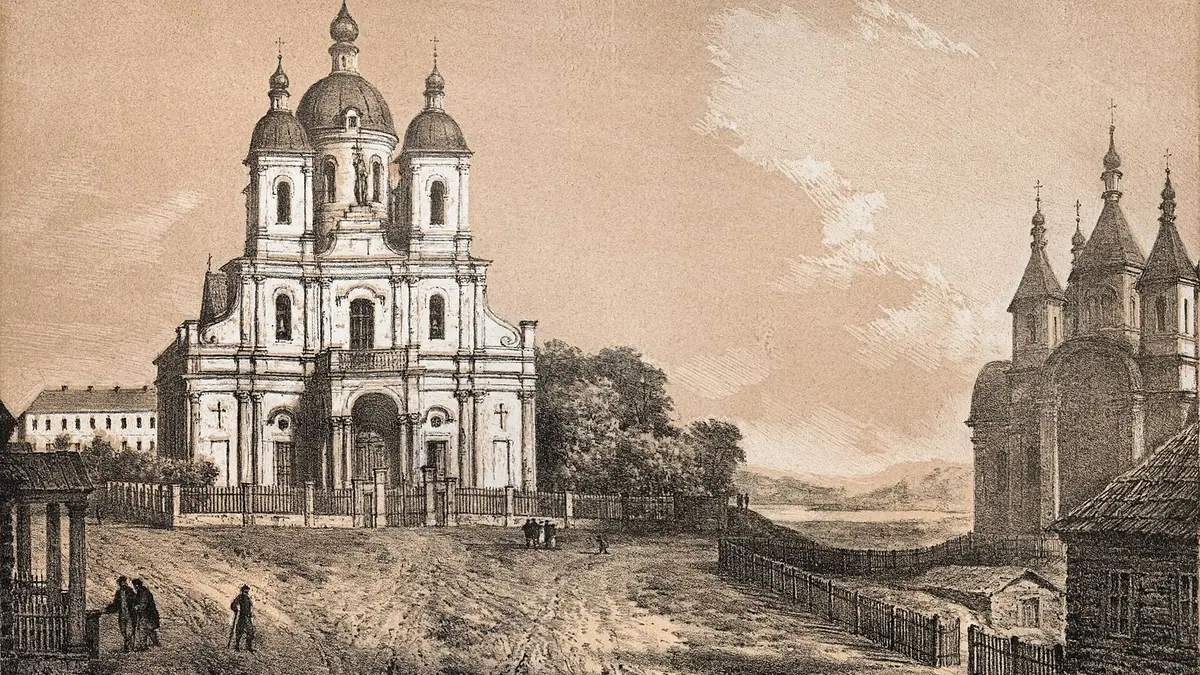
The Shrine of Our Lady of Białynicze
For centuries Białynicze on the Druts river was one of the most important Marian shrines of the old Polish–Lithuanian Commonwealth, known as the “Częstochowa of Belarus”. The Carmelite church with the miraculous image of Our Lady, crowned in 1761, was destroyed in Soviet times.
Today the parish is rebuilding the shrine, and every Mass requested here supports this work.
History of the shrine →Request a Holy Mass
Leave your contact details and intention – we will reply by e-mail with a proposed date.
Thank you! We have received your request and will reply shortly to the e-mail address you gave.