
 gregorianka.belynichi@gmail.com
Purgatory in the Teaching of the Catholic Church
In the Church's teaching, purgatory is the final purification of those who have died in God's friendship and are already assured of salvation. Drawing on the Catechism (CCC 1030–1032) and documents of the Magisterium, we explain what purgatory is, what it is not, and how we can help the souls in purgatory.
What purgatory is – the Catechism's definition
The Catechism of the Catholic Church devotes three short paragraphs to purgatory (CCC 1030–1032). The first says whom the purification concerns:
“All who die in God's grace and friendship, but still imperfectly purified, are indeed assured of their eternal salvation; but after death they undergo purification, so as to achieve the holiness necessary to enter the joy of heaven” (CCC 1030).
The second gives it a name: “The Church gives the name Purgatory to this final purification of the elect, which is entirely different from the punishment of the damned” (CCC 1031). The third shows what this teaching rests on – the practice of prayer for the dead – and how we can help the dead (CCC 1032).
Three things follow from these sentences. Purgatory concerns the saved, not the damned. It is a purification, not God's revenge. And it is final – it completes a journey that began on earth. The Catechism explains that sin, even when forgiven, leaves in a person an unhealthy attachment to creatures that needs to be purified; this “temporal punishment” is not to be understood as a kind of vengeance inflicted by God from outside, but as something that follows from the very nature of sin (CCC 1472).
Where the Church's teaching comes from
Sacred Scripture. The Catechism cites 2 Macc 12:46: Judas Maccabeus “made atonement for the dead, that they might be delivered from their sin”. Tradition sees a reference to a cleansing fire in 1 Cor 3:15 and 1 Pet 1:7 (CCC 1031). The Catechism also quotes St Gregory the Great, who concluded from Mt 12:32 that certain offences can be forgiven in the age to come – the same pope after whom Gregorian Masses are named.
The practice of the Church. From the first centuries Christians prayed for the dead and offered the Eucharist for them (CCC 1032). We would not pray for the dead if there were no state in which our prayer could help them. We write more about this practice in the article prayer for the dead.
The Councils. The Catechism states that the Church formulated her teaching on purgatory above all at the Councils of Florence and Trent (CCC 1031). The Council of Florence (1439), in its decree for the Greeks, declared that the souls of the truly penitent who died in the love of God before making satisfaction for their sins are purified after death, and that they are helped by the prayers of the living faithful: Masses, prayers, almsgiving and other works of piety. The Council of Trent, in its decree on purgatory (1563), confirmed that purgatory exists and that the souls detained there are helped by the prayers of the faithful, above all by the Sacrifice of the altar. The same decree instructed bishops to leave out of sermons to the people difficult and subtle questions that do not serve edification, and to remove whatever smacks of curiosity or superstition.
What purgatory is not
- It is not a “second chance”. Death ends the time in which a person accepts or rejects God's grace (CCC 1021). St John Paul II said that the state of purification is not a prolongation of the earthly condition, as if after death one were given another opportunity to change one's destiny (General Audience, 4 August 1999). No one who has rejected God goes to purgatory – it is passed through by those who are already saved.
- It is not a “milder hell”. The Catechism stresses that it is “entirely different from the punishment of the damned”. The souls in purgatory are already in God's love and are certain of heaven.
- It is not a place in the geographical sense. In the same catechesis John Paul II explained that the term “purgatory” does not indicate a place, but a condition of existence.
- It cannot be measured by the clock. Benedict XVI wrote that we cannot calculate the “duration” of this purifying encounter with Christ in terms of the chronological measurements of this world (Spe salvi 47). That is why the Church does not teach how long purgatory “lasts”, nor does she convert prayers into days.
Who the souls in purgatory are
The souls in purgatory – often called the holy souls – are the dead who are undergoing this final purification. They belong to the same community of the Church as we do: the communion of saints, which unites believers on earth, the dead who are being purified and the saints in heaven (CCC 954–959). Tradition calls them the “Church suffering”, but this is not suffering without hope: Benedict XVI describes it as “a blessed pain, in which the holy power of his love sears through us like a flame” (Spe salvi 47).
Many stories have grown up around purgatory – of souls appearing, of a precise number of years, of “price lists” for prayers. The Church does not tie her teaching to any of them. Even private revelations recognised by the Church do not belong to the deposit of faith (CCC 67). On this page we rely solely on Sacred Scripture, the Catechism and documents of the Magisterium.
How we can help the souls in purgatory
CCC 1032 lists them plainly: prayer, above all the Eucharistic sacrifice, as well as almsgiving, indulgences and works of penance. Benedict XVI adds that our prayer for a dead person can play a small part in his or her purification (Spe salvi 48).
- Holy Mass – a single Mass, a novena, or thirty Gregorian Masses for one person; a practical guide: Mass for the dead.
- Indulgences – especially the plenary indulgence for the dead from 1 to 8 November; see the conditions for gaining the indulgence.
- Personal prayer and remembrance of the dead – the “Eternal rest”, the Rosary, annual remembrance of the dead.
- Almsgiving and good works offered for the deceased.
If you would like to offer Masses for someone who has died, you can request Gregorian Masses or another intention at the Parish of Our Lady of Białynicze.
Sources
- Catechism of the Catholic Church, nos. 1030–1032 (the final purification, or purgatory): vatican.va
- Catechism of the Catholic Church, nos. 1021–1022 (the particular judgement): vatican.va
- Catechism of the Catholic Church, nos. 1471–1479 (indulgences, temporal punishment): vatican.va
- Catechism of the Catholic Church, nos. 954–959 (the communion of saints): vatican.va
- Benedict XVI, encyclical Spe salvi, nos. 45–48: vatican.va (in Polish)
- John Paul II, General Audience of 4 August 1999 (on purgatory): vatican.va
- Council of Florence, decree for the Greeks (1439), DS 1304; Council of Trent, decree on purgatory (1563), DS 1820 – as cited in the notes to CCC 1031.
Questions and answers
Can Gregorian Masses be requested for all the souls in purgatory?
No. Gregorian Masses are offered only for one particular deceased person. For all the souls in purgatory you can, however, request a single Mass or a novena, for example with the intention “for the holy souls in purgatory”.
How can I know whether someone I love is in purgatory?
We cannot know. The Church declares some of the dead to be saints, but she never declares of anyone that they are in purgatory. That is why we pray for every deceased person with trust, without trying to decide what state they are in – that judgement belongs to God.
Is the teaching on purgatory a dogma?
Yes. That there is a purification after death and that the prayers of the living help the dead belong to the teaching of the faith, which the Church formulated at the Councils of Florence and Trent (CCC 1031). How this purification takes place remains a mystery, and the Church does not describe it in detail.
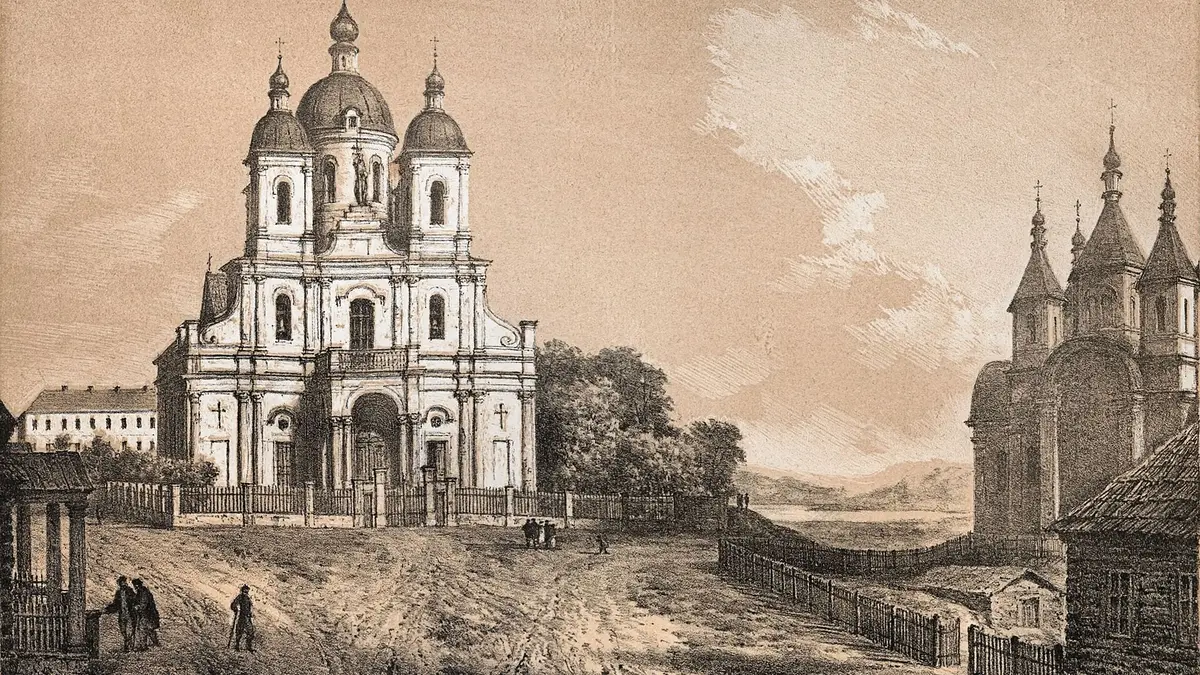
The Shrine of Our Lady of Białynicze
For centuries Białynicze on the River Drut was one of the most important Marian shrines of the Polish–Lithuanian Commonwealth, known as the “Częstochowa of Belarus”. The Carmelite church with the miraculous image of Our Lady, crowned in 1761, was destroyed in Soviet times.
Today the parish is rebuilding the shrine, and every Mass requested here supports this work.
History of the shrine →Request a Holy Mass
Leave your contact details and intention – we will reply by e-mail with a proposed date.
Thank you! We have received your request and will reply shortly to the e-mail address you gave.