
 gregorianka.belynichi@gmail.com
A collective Mass and a Mass for one intention – what is the difference?
Notices of “collective” Masses for many intentions are becoming more common. We explain how they differ from a Mass for one intention, what the 1991 decree “Mos iugiter” and the new 2025 norms say about them, and why Gregorian Masses are not celebrated as a collective Mass.
In brief
A Mass for one intention (an individual Mass) is a Mass applied for the intention of one donor – for each offering accepted the priest celebrates a separate Mass (can. 948). A collective Mass is a single Mass in which the offerings and intentions of many different donors are combined. The Church permits it as an exception – only when each donor has been clearly informed beforehand and has freely consented. Gregorian Masses cannot be celebrated as a collective Mass, because they are a series of thirty Masses for one deceased person.
Three situations that are easily confused
| Who is asking | How many offerings | What it means | |
|---|---|---|---|
| Mass for one intention | one person or one group (e.g. a family) | one | the whole Mass is applied for that intention |
| One intention for several people | one donor | one | this is still an individual Mass, e.g. “for our late parents” |
| Collective Mass | many independent donors | many | one Mass for all the intentions gathered – only with their explicit consent |
What matters, then, is not how many names are mentioned in the intention, but how many donors have made separate offerings expecting separate Masses. A family that asks together for one Mass for their grandparents is not requesting a collective Mass. We write about who can ask for a Mass and for whom in who can request a Mass, and for whom.
What the decree “Mos iugiter” (1991) says
The decree of the Congregation for the Clergy Mos iugiter of 22 February 1991, approved by John Paul II, was issued because the practice of “collective intentions” had become widespread in some countries. The document calls the arguments in its favour “specious and contrived” and points to two dangers: a failure of justice towards the donors, and a gradual loss among the faithful of an understanding of what an offering for a Mass for a particular intention is.
At the same time the decree clarifies two situations that are not an abuse: when the faithful – especially in poor regions – bring small offerings without asking for a separate Mass for each, these may be combined and as many Masses celebrated as correspond to the offering fixed in the diocese; and the faithful “are always free” to combine their own intentions and offerings and ask for one Mass.
The decree permits a collective Mass in the proper sense as an exception: the donors must be told in advance and give their consent, and the day, place and time of such a Mass are made public, not more than twice a week. The document warns that if this practice were to spread excessively, it would have to be regarded as an abuse. A separate article (art. 4) obliges the rectors of shrines and places of pilgrimage, where many intentions arrive, to take particular care that these rules are observed.
In 2025 the Dicastery for the Clergy issued a new decree: the bishops of an ecclesiastical province may set the conditions for collective Masses in their territory, while the donors' consent “may never be presumed”. Where no such norms have been issued, Mos iugiter remains in force. We discuss the exact wording of both documents and their place within the canons in the article Mass intentions in the Code of Canon Law.
A Mass and a mere “mention” of a name
The 2025 decree also recalls a distinction that matters to anyone who requests prayer: a Mass applied for a specific intention is one thing, and a mere mention of a name during the liturgy, for example in the Prayer of the Faithful, is another. The document calls accepting offerings for such a mention as if it were a Mass gravely wrong. That is why, for example, remembrance of the dead is honestly described as a shared prayer of the parish and not as a Mass for an intention – we also write about this difference in Gregorian Masses or a novena.
Why Gregorian Masses cannot be collective
Gregorian Masses are thirty Masses celebrated day after day for “an intention for one deceased person only”. This form goes back to the event described by St Gregory the Great, who ordered Mass to be offered for thirty days for one deceased monk – see the history of Gregorian Masses. If one of these Masses were offered at the same time for many people gathered from different donors, the series would cease to be a series for that one person. That is why, in our view – and in keeping with how parishes and religious orders describe Gregorian Masses – they cannot be reconciled with the form of a collective Mass, even with the donors' consent.
This does not mean that a collective Mass “helps less”: every Eucharist is the Sacrifice of Christ. It is a matter of faithfulness to a specific practice recognised by the Church, whose rules we describe in the article what are Gregorian Masses.
An individual intention in Białynicze
When you choose “Individual Mass intention” or Gregorian Masses in the form, you are asking for a Mass (or a series of Masses) for your intention – as provided for in can. 948. You can submit the intention through the form, by e-mail or via WhatsApp. We reply by e-mail suggesting a date and times, and once the offering has been made to the parish account, within two days at the latest we send a confirmation with the wording of the intention and the date and time of each Mass. The Masses are celebrated first and foremost at the shrine in Białynicze. Request an intention or Gregorian Masses; we describe the principles of the offering on the page the Mass offering.
Sources
- Congregation for the Clergy, decree Mos iugiter, 22.02.1991, AAS 83 (1991), pp. 443–446 – vatican.va (in Italian)
- Dicastery for the Clergy, decree on the discipline of Mass intentions, 13.04.2025 – vatican.va (PDF, in Italian)
- Code of Canon Law, cann. 945–958 – vatican.va
- Jesuits, St Stephen's Parish, “Intencje mszalne” (in Polish) – szczepan.jezuici.pl
Questions and answers
How can I know that the Mass I request will not be a collective one?
According to the decree, a collective Mass may be celebrated only with your prior, explicit consent – silence is not consent. If no one has asked you for it, your offering means a separate Mass. If in doubt, simply ask the parish when you make your request.
Can Gregorian Masses be celebrated in a church where collective Masses are also celebrated?
Yes. What matters is that each of the thirty Masses is applied for that one deceased person – not what other Masses are celebrated in the church. Nor do Gregorian Masses have to be celebrated in one church or by one priest: see must Gregorian Masses be celebrated in one church?
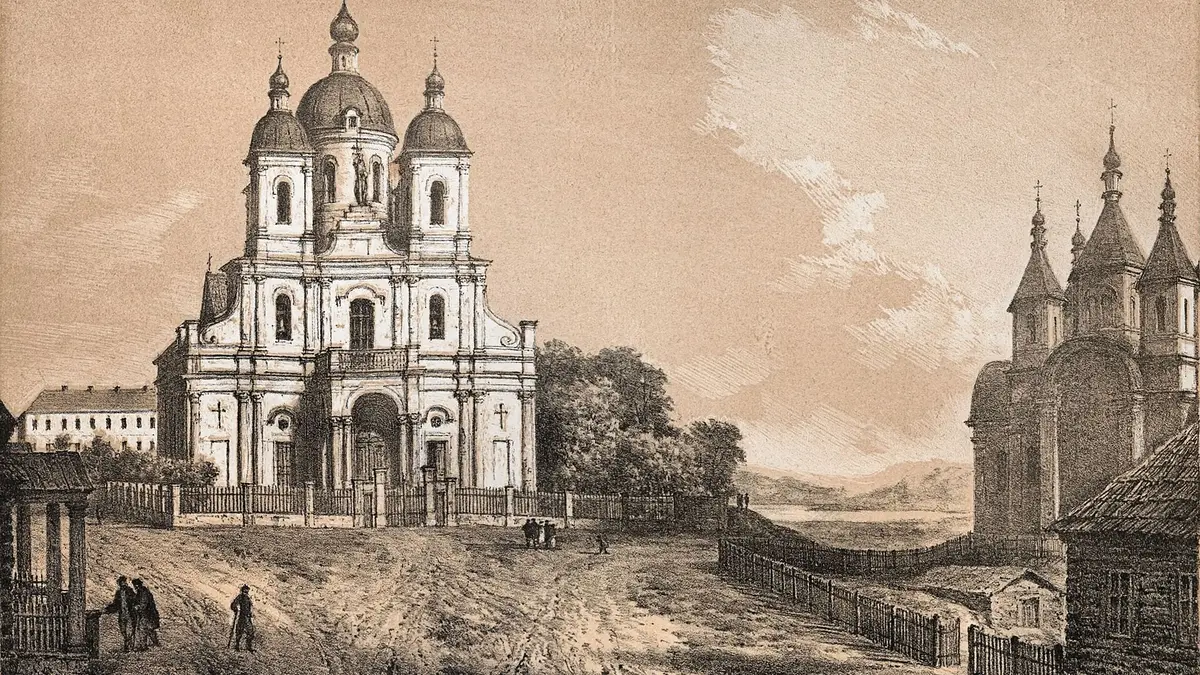
The Shrine of Our Lady of Białynicze
For centuries Białynicze on the River Drut was one of the most important Marian shrines of the Polish–Lithuanian Commonwealth, known as the “Częstochowa of Belarus”. The Carmelite church with the miraculous image of Our Lady, crowned in 1761, was destroyed in Soviet times.
Today the parish is rebuilding the shrine, and every Mass requested here supports this work.
History of the shrine →Request a Holy Mass
Leave your contact details and intention – we will reply by e-mail with a proposed date.
Thank you! We have received your request and will reply shortly to the e-mail address you gave.