
 gregorianka.belynichi@gmail.com
Mass intentions in the Code of Canon Law – cann. 945–958
The Code of Canon Law devotes fourteen canons (945–958) to Mass intentions and offerings. We go through them in order – from the principle “one offering, one Mass”, through concelebration, time limits and the transfer of intentions, to the register of intentions – and explain what follows from them for Gregorian Masses.
Where the Code deals with Mass intentions
The rules for accepting intentions and offerings for Masses are found in the 1983 Code of Canon Law – in Book IV, in the title on the Most Holy Eucharist, in Chapter III, entitled “The offering given for the celebration of Mass” (cann. 945–958). These are fourteen short canons that protect two things: the will of the faithful person who asks for a Mass, and the dignity of the Eucharist itself. Below we go through them in order, quoting the English translation of the Code. You will find a broader, less legal overview on the page Mass intentions.
| Canon | What it covers |
|---|---|
| 945–947 | the priest's right to accept an offering, the meaning of the offering, the ban on any appearance of trade |
| 948–950 | a separate Mass for each offering accepted, the lasting nature of the obligation |
| 951 | bination and concelebration in relation to the offering |
| 952 | the amount of the offering |
| 953–956 | how many intentions may be accepted, transferring intentions, time limits |
| 957–958 | oversight and the register of intentions |
Mass offerings in canon law (cann. 945–947, 952)
Can. 945 § 1 states: “In accord with the approved practice of the Church, any priest celebrating or concelebrating is permitted to receive an offering to apply the Mass for a specific intention.” Paragraph 2 adds: “It is recommended earnestly to priests that they celebrate Mass for the intention of the Christian faithful, especially the needy, even if they have not received an offering.”
Can. 946 explains the meaning of the offering: the faithful who give it “contribute to the good of the Church and by that offering share its concern to support its ministers and works”. Can. 947 is short and firm: “Any appearance of trafficking or trading is to be excluded entirely from the offering for Masses.” That is why we speak of an offering, not a price.
The amount of the offering for one Mass is fixed by decree of the provincial council or the meeting of the bishops of the province; a priest may not ask for more, but he may freely accept a larger offering, and also a smaller one (can. 952 § 1). Where there is no such decree, the custom of the diocese applies (§ 2), and members of religious institutes follow the same arrangements (§ 3). How we understand the offering in our parish is explained on the page the Mass offering.
One Mass – one intention (cann. 948–950)
The most important principle of the whole chapter is can. 948: “Separate Masses must be applied for the intentions of those for whom a single offering, although small, has been given and accepted.” Each offering accepted therefore means a separate Mass – whether the offering was large or merely symbolic.
The obligation is lasting. According to can. 949, a person obliged to celebrate Mass for the intention of those who gave an offering “is bound by the obligation even if the offerings received have been lost through no fault of his own”. Can. 950 settles the case where someone gives a sum of money without specifying the number of Masses: the number is calculated on the basis of the offering customary in the place where the donor lives, unless the donor's intention was otherwise.
From the point of view of the faithful, this means it is worth stating clearly for whom and for what the Mass is to be celebrated. We have gathered some advice in the guide how to word a Mass intention.
Collective intentions: the decree “Mos iugiter” (1991) and the 2025 decree
There is one exception to the principle of can. 948. The decree of the Congregation for the Clergy Mos iugiter of 22 February 1991 (AAS 83 (1991), pp. 443–446) first recalls that priests who combine offerings “without the knowledge of the offerers” and celebrate a single Mass for a collective intention act against the law (art. 1 § 2). A single Mass for a collective intention is permitted only when the offerers, “previously and explicitly informed, freely consent” (art. 2 § 1). The place and time of such a Mass must then be made public, “not more than twice a week” (art. 2 § 2), and the celebrant may keep only the one offering fixed in the diocese (art. 3).
On 13 April 2025 Pope Francis approved a decree of the Dicastery for the Clergy on the discipline of Mass intentions (in force from 20 April 2025). It allows the provincial council or the meeting of the bishops of the province to set out by decree the conditions for “collective” Masses – still only when all the offerers have been informed and have freely consented; such consent “may never be presumed” (art. 1 §§ 1–2). Where the bishops of the province do not decide otherwise, Mos iugiter continues to apply (art. 6). The decree also stresses the difference between a Mass celebrated for a specific intention and merely mentioning someone during the liturgy (art. 4 § 2).
Concelebrated Mass and the intention; bination (cann. 945, 951)
A concelebrating priest may accept an offering and apply the Mass for a specific intention just as the principal celebrant does – can. 945 § 1 says so explicitly (“celebrating or concelebrating”). The restriction concerns a second Mass on the same day: “A priest who concelebrates a second Mass on the same day cannot receive an offering for it under any title” (can. 951 § 2).
When a priest may celebrate more than once a day at all is laid down in can. 905 (bination and, on Sundays and holy days of obligation – with the Ordinary's permission – also trination). If he does so, he may apply each of these Masses for an intention for which an offering has been given, but – except on Christmas Day – he keeps only one offering for himself; the others he passes on for purposes prescribed by the Ordinary, although he may receive some recompense on an extrinsic title (can. 951 § 1).
How many intentions a priest may accept, and the time limit (cann. 953, 955 § 2, 956)
Can. 953: “No one is permitted to accept more offerings for Masses to be applied by himself than he can satisfy within a year.” This is an upper limit – it does not mean the faithful have to wait a year. If the donor asks for a specific day (e.g. the anniversary of a death), the priest accepts the intention with precisely that obligation.
Can. 955 § 2 says from when the time is counted: “The time within which Masses must be celebrated begins on the day the priest who is to celebrate them received them unless it is otherwise evident.” The 1983 Code does not set a general number of days or months for a single Mass; the limit of a year does appear in can. 956, however: administrators of pious causes and all who are obliged to see to the celebration of Masses must hand over to their own Ordinaries those obligations that have not been fulfilled within a year. The decree Mos iugiter (art. 5) asks priests who are unable to fulfil the intentions they have accepted within a year not to refuse them, but to pass them on to other priests or to the Ordinary.
Can a priest pass an intention on to another priest? (cann. 954–955)
Yes – the Code provides for this explicitly. Can. 954: if in certain churches more Masses are requested than can be celebrated there, “it is permitted for them to be celebrated elsewhere unless the donors have expressly indicated a contrary intention”. So if a particular church or priest matters to you, say so when you make your request.
Can. 955 § 1 sets out the conditions: the intentions must be passed on “as soon as possible” to priests of whom one is certain that they “are above suspicion”; the entire offering received is passed on (unless the excess over the diocesan amount was clearly given to the priest personally). Whoever has passed on an intention remains responsible for its celebration “until he learns that the obligation has been accepted and the offering received”.
Records of Mass intentions (cann. 955 §§ 3–4, 957–958)
The law requires accurate records at three levels:
- the priest – “must note accurately the Masses he has accepted to celebrate and those he has satisfied” (can. 955 § 4);
- the one who passes on intentions – records in a book the Masses received and passed on, together with their offerings (can. 955 § 3);
- the parish priest or rector of the church where intentions are accepted – keeps a special book in which he notes “the number of Masses to be celebrated, the intention, the offering given, and their celebration” (can. 958 § 1).
The Ordinary is to inspect these books every year, personally or through others (can. 958 § 2), and the local Ordinary oversees the fulfilment of Mass obligations – in churches of religious, their superiors do so (can. 957).
Canon law and Gregorian Masses
Canons 945–958 do not mention Gregorian Masses by name, but they apply to them fully. Gregorian Masses are thirty separate Masses, each of which – in accordance with can. 948 – is offered for one intention: for one deceased person, on thirty consecutive days. For this reason Gregorian Masses are not combined with collective intentions, and other deceased persons are not added to them.
The detailed rules on the continuity of the series were set out in the declaration “Tricenario Gregoriano” of 1967: a series interrupted by an unforeseen impediment retains its fruits, and the priest is to make up the missing Masses as soon as possible. We write more about this in the article can Gregorian Masses be interrupted? The Masses need not be celebrated by the same priest or at the same altar – see must Gregorian Masses be celebrated in one church? Passing part of the series on to another priest is then governed by cann. 954–955.
If thirty Masses is too many in your situation, compare the forms of prayer in Gregorian Masses or a novena, or request a single Mass for the dead.
How we apply these rules in Białynicze
We accept intentions through the form, by e-mail or via WhatsApp, and first reply by e-mail suggesting a date and times. The Masses are celebrated first and foremost in Białynicze, and also by priests of other parishes in eastern Belarus – that is, within the limits set by can. 955. Once the offering has been made, within two days at the latest we send a confirmation with the intention, date and time of each Mass. If you would like to entrust an intention to us, you can request Gregorian Masses or another Mass using the form.
Sources
- Code of Canon Law (1983), can. 905 and cann. 945–958 – Polish text, liturgista.pl (in Polish)
- Code of Canon Law – full Polish text (PDF, in Polish)
- Code of Canon Law, cann. 879–958 – vatican.va (English version)
- Congregation for the Clergy, decree “Mos iugiter” (22.02.1991), AAS 83 (1991), pp. 443–446 – Polish text (in Polish)
- “Mos iugiter” – description of the document, liturgista.pl (in Polish)
- Dicastery for the Clergy, decree on the discipline of Mass intentions (13.04.2025) – Vatican News (in Polish)
- Declaration “Tricenario Gregoriano” (24.02.1967; in Polish)
Questions and answers
Can I stipulate that the Mass must be celebrated only in a particular church?
Yes. Can. 954 allows an intention to be transferred elsewhere “unless the donors have expressly indicated a contrary intention”. If the place or the priest matters to you, say so when you make your request – such a wish of the donor binds the priest.
May I request a Mass without making an offering?
Yes. The Code earnestly recommends that priests celebrate Mass for the intentions of the faithful, especially the needy, even without an offering (can. 945 § 2). If the suggested offering is difficult for you, please write to us openly.
Is the offering lost if the priest falls ill before celebrating the Mass?
No. The obligation to celebrate an accepted intention remains (can. 949); if there is an impediment, the Mass can be celebrated by another priest to whom the intention has been transferred in accordance with can. 955.
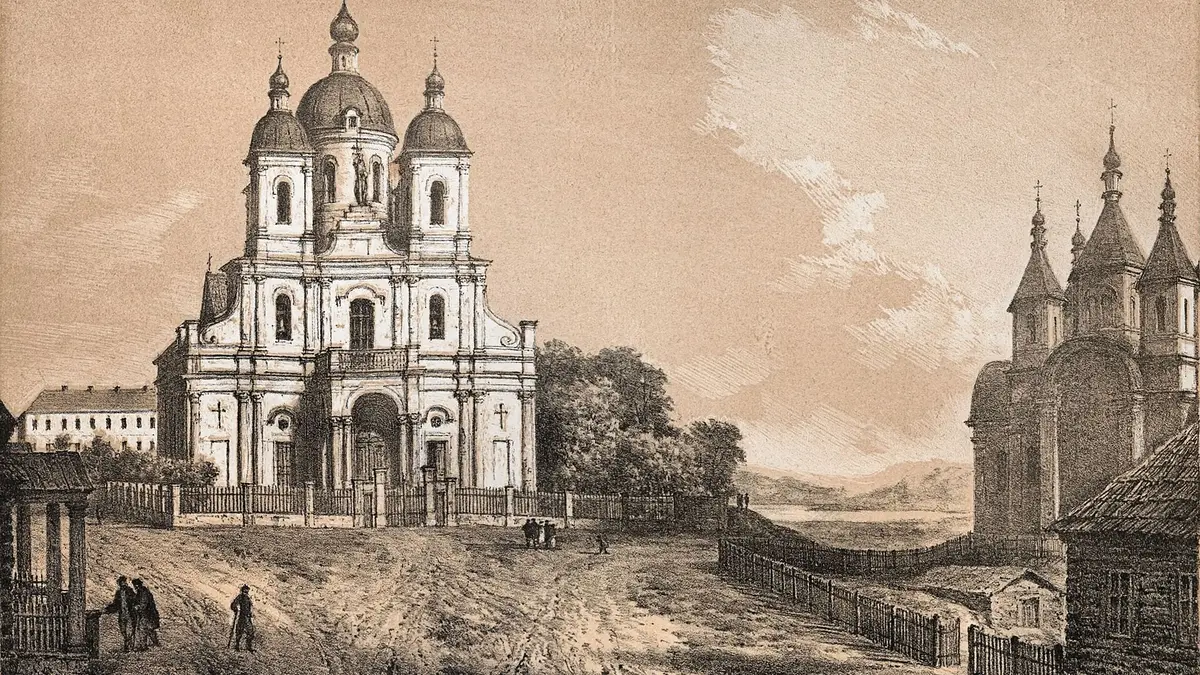
The Shrine of Our Lady of Białynicze
For centuries Białynicze on the River Drut was one of the most important Marian shrines of the Polish–Lithuanian Commonwealth, known as the “Częstochowa of Belarus”. The Carmelite church with the miraculous image of Our Lady, crowned in 1761, was destroyed in Soviet times.
Today the parish is rebuilding the shrine, and every Mass requested here supports this work.
History of the shrine →Request a Holy Mass
Leave your contact details and intention – we will reply by e-mail with a proposed date.
Thank you! We have received your request and will reply shortly to the e-mail address you gave.