
 gregorianka.belynichi@gmail.com
Prayers for the holy souls in purgatory – chaplet, St Gertrude prayer, litany
A practical prayer book for the dead: the full texts of the “Eternal rest” and Psalm 130, how to pray the chaplet for the dead, the prayer attributed to St Gertrude with an honest comment, and suggestions on when to pray.
In brief
Any prayer offered for the holy souls in purgatory can help them. The prayers most often said are the “Eternal rest”, Psalm 130 “Out of the depths”, the Rosary or a chaplet, and the prayer attributed to St Gertrude. The most precious gift remains Holy Mass (CCC 1032). Below we have gathered the texts and how to pray them – why the Church prays for the dead is explained on the page Catholic prayer for the dead.
Eternal rest
The shortest and best-known prayer for the dead, taken from the Latin liturgy (Requiem aeternam):
Eternal rest grant unto them, O Lord,
and let perpetual light shine upon them.
May they rest in peace.
Amen.
For one person: “Eternal rest grant unto him (her), O Lord… May he (she) rest in peace.” Prayers for the dead are often concluded with the ancient invocation: “May the souls of the faithful departed, through the mercy of God, rest in peace. Amen.” The Church attaches a partial indulgence, which can be offered for the dead, to the “Eternal rest” – details on the page indulgence for the dead.
Psalm 130 (129) – “Out of the depths”
A penitential psalm, known in the Latin tradition as the De profundis, prayed for the dead for centuries in the liturgy, at graves and in the evening at home. The text in the Revised Standard Version, Catholic Edition:
Out of the depths I cry to thee, O LORD!
Lord, hear my voice!
Let thy ears be attentive
to the voice of my supplications!
If thou, O LORD, shouldst mark iniquities,
Lord, who could stand?
But there is forgiveness with thee,
that thou mayest be feared.
I wait for the LORD, my soul waits,
and in his word I hope;
my soul waits for the LORD
more than watchmen for the morning,
more than watchmen for the morning.
O Israel, hope in the LORD!
For with the LORD there is steadfast love,
and with him is plenteous redemption.
And he will redeem Israel
from all his iniquities.
The psalm is followed by the “Eternal rest”. Other biblical roots of this prayer are discussed in prayer for the dead in the Bible.
The chaplet for the dead – how to pray it
The “chaplet for the dead” has no single official form – prayer books give several versions. The simplest, prayed on ordinary Rosary beads, goes like this:
- On the crucifix and the first beads: the Apostles' Creed, the Our Father and three Hail Marys.
- On each large bead: the Our Father (or Psalm 130, or the invocation “May the souls of the faithful departed…”).
- On each of the ten small beads: Eternal rest grant unto them, O Lord…
- To conclude: May the souls of the faithful departed, through the mercy of God, rest in peace. Amen.
Five decades give fifty “Eternal rests”; some people pray the five decades twice – hence the familiar name “the hundred Eternal rests”. The number has no magical meaning: what counts is the faith and love with which we commend the dead to God.
The Chaplet of Divine Mercy for the dead
Many of the faithful offer the Chaplet of Divine Mercy for the dead. Its text comes from the Diary of St Faustina (no. 476) and is prayed without changes; the intention – “for the soul of N.” or “for the holy souls in purgatory” – is stated at the beginning:
- at the beginning: the Our Father, the Hail Mary, the Apostles' Creed;
- on the large beads: Eternal Father, I offer You the Body and Blood, Soul and Divinity of Your dearly beloved Son, Our Lord Jesus Christ, in atonement for our sins and those of the whole world.
- on the small beads (10 times): For the sake of His sorrowful Passion, have mercy on us and on the whole world.
- to conclude (3 times): Holy God, Holy Mighty One, Holy Immortal One, have mercy on us and on the whole world.
The St Gertrude prayer for the holy souls
This short prayer is attributed to St Gertrude the Great of Helfta (d. c. 1302), a nun and mystic. In its popular English form:
Eternal Father, I offer Thee the Most Precious Blood of Thy Divine Son, Jesus,
in union with the Masses said throughout the world today,
for all the holy souls in purgatory, for sinners everywhere,
for sinners in the universal Church, those in my own home and within my family.
Amen.
An honest note. The prayer is often accompanied by a “promise” that each time it is said a thousand souls are released from purgatory. This promise is not found in the writings of St Gertrude, and the Church has never confirmed it – it is a later, private tradition. The prayer itself is beautiful and sound: it unites us with the Sacrifice of Christ offered at every Mass. But the Church does not convert prayers into a “number of souls” or into days (see purgatory in Catholic teaching), and even approved private revelations do not belong to the deposit of faith (CCC 67).
Litany and Rosary
In prayer books you will also find a litany for the dead – in several versions, for private use; choose a text from a prayer book published with Church approval. You can also offer a whole Rosary for the dead, or one decade a day, adding the “Eternal rest” after each.
When to pray
- November – traditionally the month of prayer for the dead; 2 November is All Souls' Day, and from 1 to 8 November a plenary indulgence for the dead can be gained;
- Anniversaries – of the death, the birthday or the name day of someone close to you;
- Every day – one “Eternal rest” after night prayers or after grace at meals;
- At the grave, and when passing a cemetery.
Prayers for deceased parents, a husband, a wife or a child are gathered separately in prayer for deceased parents.
The Mass – the greatest prayer for the dead
All these prayers find their centre in the Eucharist, which the Church has offered for the dead from the beginning (CCC 1371). For all the holy souls you can request a single Mass or a novena of Masses for the dead, and for one particular person – thirty Gregorian Masses. Choose the form in the request form; we agree the details and dates in our e-mail reply. More practical information is in our guide Mass for the dead.
Sources
- Biblia Tysiąclecia – Psalm 130 (129) (in Polish)
- Catechism of the Catholic Church – nos. 67, 1032, 1371
- Diary of St Faustina – no. 476 (the Chaplet of Divine Mercy)
- Fr J. Zuhlsdorf, “Does the St. Gertrude Prayer release 1000 souls from Purgatory?” – on the origin of the “promise of 1000 souls”
Questions and answers
Do prayers for the holy souls have to be said in church?
No. They can be said at home, on the way, at the graveside. The Church does, however, encourage us to unite them with taking part in Holy Mass, and some indulgences for the dead are linked with visiting a church or a cemetery.
May I change the words of these prayers?
Liturgical texts and the Chaplet of Divine Mercy are prayed as they stand, but a personal prayer for someone who has died can be said in your own words. God does not need formulas – formulas help us when our own words fail.
Can the souls in purgatory pray for us?
The Catechism teaches that our prayer for the dead can not only help them but also make their intercession for us effective (CCC 958). The Church does not, however, define how and when this happens.
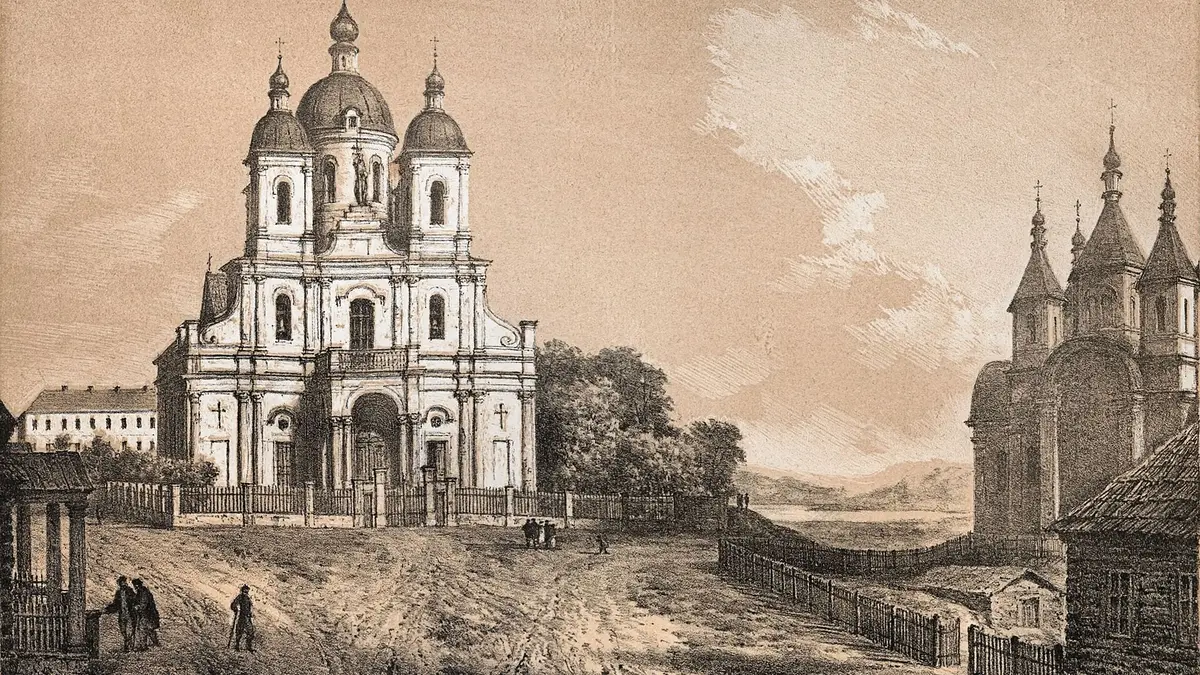
The Shrine of Our Lady of Białynicze
For centuries Białynicze on the River Drut was one of the most important Marian shrines of the Polish–Lithuanian Commonwealth, known as the “Częstochowa of Belarus”. The Carmelite church with the miraculous image of Our Lady, crowned in 1761, was destroyed in Soviet times.
Today the parish is rebuilding the shrine, and every Mass requested here supports this work.
History of the shrine →Request a Holy Mass
Leave your contact details and intention – we will reply by e-mail with a proposed date.
Thank you! We have received your request and will reply shortly to the e-mail address you gave.