
 gregorianka.belynichi@gmail.com
Who can request a Mass, and for whom?
Can someone from outside the parish request a Mass? Can you request a Mass for yourself, for someone who is not Catholic, or without giving your own name? We answer on the basis of the Code of Canon Law and explain why Gregorian Masses are an exception – always for one deceased person.
In brief
Anyone can request a Mass for their intention: you do not have to be a parishioner, live in Belarus or put your own name in the intention. A priest may offer Mass for anyone – for the living and for the dead (can. 901), including for the person requesting it and for people who are not Catholics. One restriction applies to Gregorian Masses: the thirty Gregorian Masses are always offered for one deceased person.
Who can request a Mass
The Code of Canon Law speaks of the faithful who give an offering so that Mass may be applied for their intention (can. 946), but it sets no conditions for the person making the request. There is no requirement to belong to the parish where the Mass will be celebrated, nor to show any certificates. So a Mass can be requested by:
- a family member, friend, neighbour or colleague of the deceased;
- someone on behalf of another person – for example a granddaughter filling in the form for a grandmother who does not use the internet;
- a community: a Rosary group, a school class, a workplace;
- someone who does not practise their faith but wants to surround a loved one with prayer.
A Mass offering is a gift, not a fee (can. 947) – so no one “buys” the right to a Mass and no one has to qualify for it. What matters is the request addressed to God through the Church.
For whom a Mass can be requested
Can. 901 states briefly that a priest may offer (apply) Mass for anyone – for the living and for the dead. Several practical answers follow from this.
Can I request a Mass for myself?
Yes. An intention for oneself is entirely proper and has long been common: in thanksgiving for graces, for health, for a good decision, for the grace of conversion or for a happy death. It is usually phrased in the first person or descriptively, e.g. “In thanksgiving for graces received, asking for God's continued blessing on me and my family”. We give more examples in the guide how to word a Mass intention.
For the living and for the dead
For the living, Masses are requested in times of need, in thanksgiving and for anniversaries – you will find examples in the articles on the Mass for the sick and for healing and the Mass of thanksgiving. For the dead – a single Mass, a novena or a series of thirty Masses; our guide to these forms is the page Mass for the dead. The person for whom we pray does not need to know about it or give consent: praying for someone is an act of love, not an obligation on that person.
For people of other denominations or none
The canon makes no distinction here, so a Mass can also be requested for an Orthodox grandfather or for a friend who did not believe. We write more about this – including about people who died by suicide – in the article who Gregorian Masses are for.
Can an intention be anonymous?
Yes, in the sense that the name of the person requesting the Mass does not have to appear in the intention. The customary addition “from the family” or “from the neighbours” is optional. The law requires the register of intentions to record the number of Masses, the intention, the offering and the fact of celebration (can. 958 § 1) – but it does not mention the donor's details.
The person being prayed for can also be described discreetly: “for health for Peter”, “for an intention known to God”, “for the resolution of a difficult matter”. God knows the details. All we need in order to contact you is an e-mail address (or WhatsApp), to which we will send a proposed date and the confirmation; these details are not part of the intention.
Gregorian Masses for parents, spouses or several people
Here the rule differs from an ordinary intention. Gregorian Masses are “an intention for one deceased person only”, celebrated on thirty consecutive days. A single Mass or a novena can be offered “for our late parents, John and Mary”, but thirty Gregorian Masses cannot. So for both parents, or for a husband and wife, you request two series of Gregorian Masses (they can run at the same time) or choose another form: a novena of Masses for the dead, a series of ordinary Masses or annual remembrance of the dead. You will find a comparison of these forms in Gregorian Masses or a novena. Nor are Gregorian Masses requested for a living person – for the living there are Masses to the Heavenly Court.
How to request a Mass in Białynicze
In the form choose the type of intention, enter its wording and – if a particular day matters to you – the date. You can submit the intention through the form, by e-mail or via WhatsApp. We reply by e-mail suggesting a date and times, and once the offering has been made to the parish account, within two days at the latest we send a confirmation with the wording of the intention and the date and time of each Mass. The Masses are celebrated first and foremost at the shrine in Białynicze. The steps in detail: how to request Gregorian Masses; the form: request a Mass or Gregorian Masses.
Sources
- Code of Canon Law, cann. 901, 945–948, 958 – vatican.va
- Jesuits, St Stephen's Parish, “Intencje mszalne” (Gregorian Masses for one deceased person; in Polish) – szczepan.jezuici.pl
Questions and answers
Can I request a Mass for someone who does not know about it?
Yes. Neither Church law nor custom requires the consent of the person for whom we pray. If the intention is to be read out, it is worth wording it so that it does not reveal matters the person would not want made public.
Can several people request one Mass together?
Yes. A family, neighbours or friends can make an offering together and ask for one Mass for one shared intention – it is still a single intention. How this differs from a so-called collective Mass we explain in collective Mass and a Mass for one intention.
Do I have to give the surname in an intention for someone who has died?
It is not required, but the full first name and surname help avoid mistakes, especially when the intention is read out in church. A first name with a description is also enough, e.g. “For our late mother, Helen”.
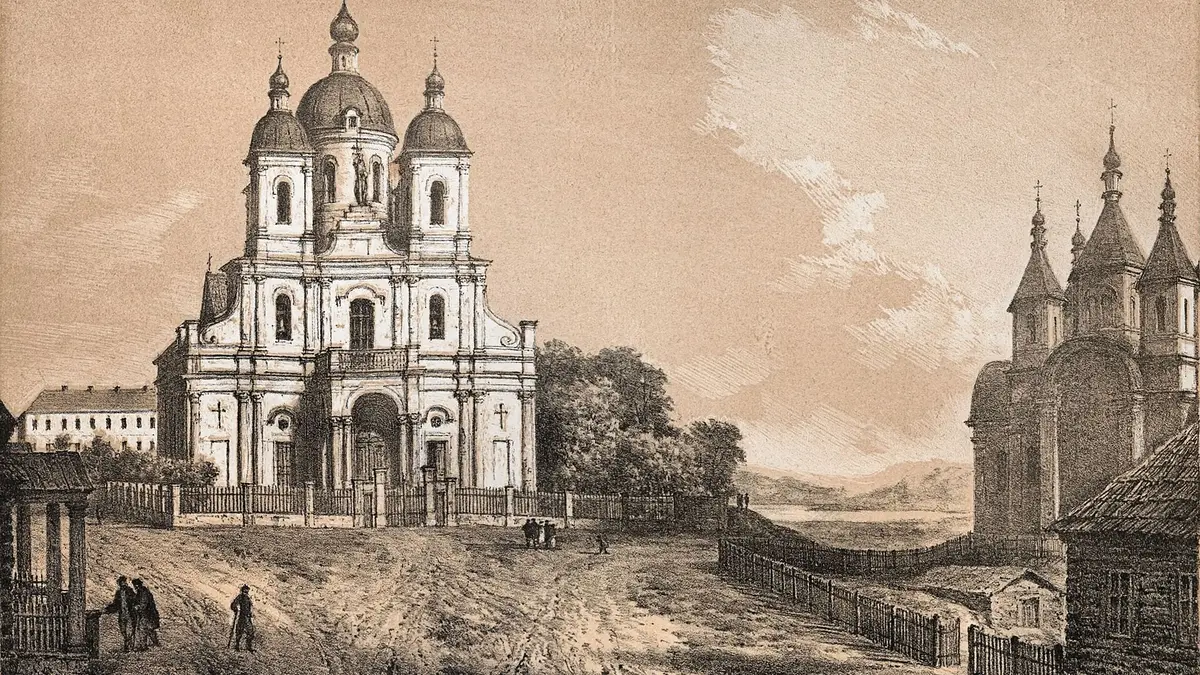
The Shrine of Our Lady of Białynicze
For centuries Białynicze on the River Drut was one of the most important Marian shrines of the Polish–Lithuanian Commonwealth, known as the “Częstochowa of Belarus”. The Carmelite church with the miraculous image of Our Lady, crowned in 1761, was destroyed in Soviet times.
Today the parish is rebuilding the shrine, and every Mass requested here supports this work.
History of the shrine →Request a Holy Mass
Leave your contact details and intention – we will reply by e-mail with a proposed date.
Thank you! We have received your request and will reply shortly to the e-mail address you gave.